

DEW #154 - Mythos <> Firefox hype, RSigma gets an uplift, Detection-as-Code is overrated and TeamPCP Strikes Again
Welcome to Issue #154 of Detection Engineering Weekly!
✍️ Musings from the life of Zack:
I’m back from Spring Break and happy to report I have no sunburns. New England Spring is here as well, and it feels like the Northeast U.S. is coming out of hibernation
I just booked Hacker Summercamp (BlackHat & DEFCON), so excited to see folks there. If anyone wants to meet up/host an event/drink Miami Vice by the pool, HMU
For my BJJ fam: if anyone wants to train at Jeremiah Grossman’s Smackdown or hit an open mat during that week, let me know :D
Webinar with Forrester: AI x Security Operations, What Works and Doesn’t Work
I’m hosting a webinar with Allie Mellen from Forrester tomorrow, where we’ll be diving deep into security operations and how AI is working and not working for all of us.
We’ve had awesome discussions around this in the past. Feel free to register and come roast me in the chat!
💎 Detection Engineering Gem 💎
A quick look at Mythos run on Firefox: too much hype? by Antide Petit
The talk of the town last week was Mozilla's blog post on how they used Anthropic’s mysterious and powerful Mythos model to find and fix 271 vulnerabilities. The blog post itself isn’t bragadocious in the way you might see vulnerability reports; in fact, it has a level-headed take on how the Mozilla team is hopeful about the scale LLMs can find vulnerabilities, but that no singular vulnerability found was something that a human couldn’t find:
So far we’ve found no category or complexity of vulnerability that humans can find that this model can’t. - Petit
They used the term “vertigo” to describe how jarring the capabilities of LLMs are in changing our perception of defense.
Luckily, this post by Petit helps ground the announcements even further into reality, with some objections to the hype of the news. Petit reviewed Firefox’s issue trackers and commit history to gather more details about the 271 reported bugs. Petit went through the commit history to map bugs to CVEs, classify by exploitability and attack surface, and figure out which of the 271 actually met the bar for a CVE or had a PoC.”
They vibe coded an excellent visualization tool with their findings, located here, with a neat dashboard shown below:
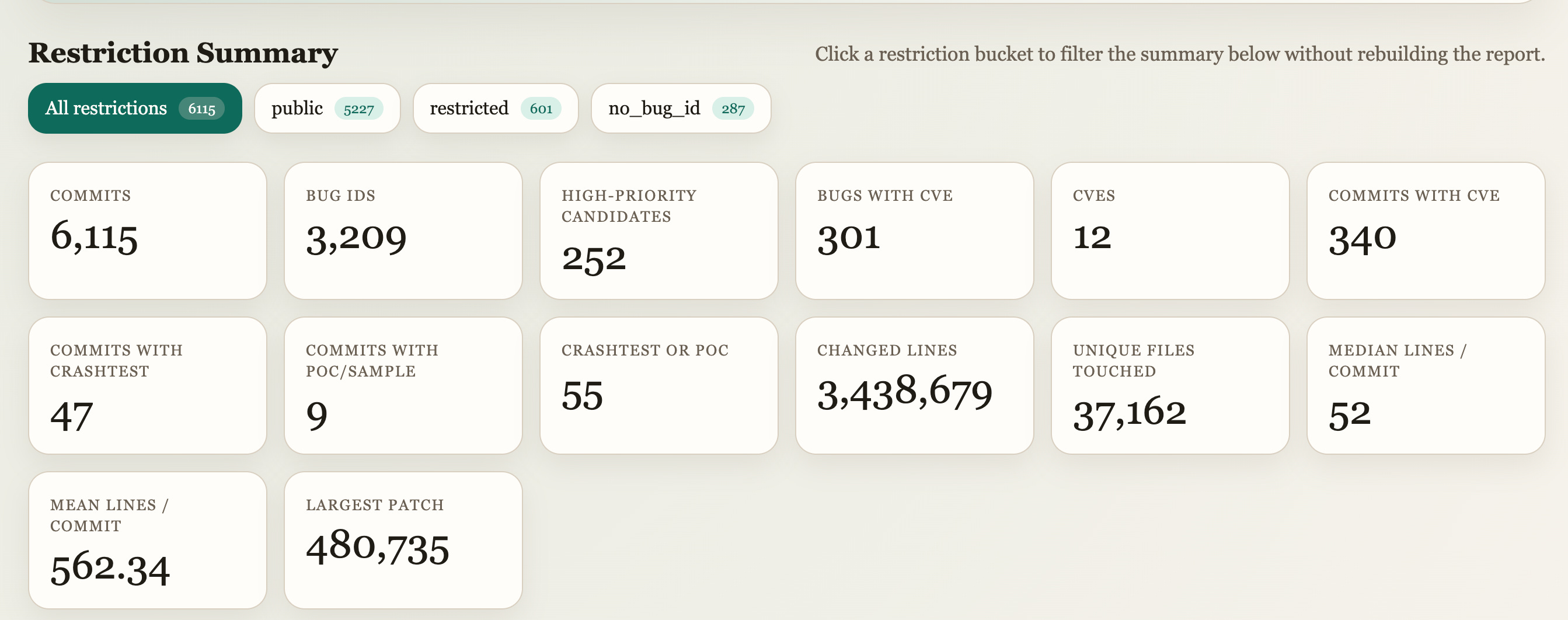
The 12 CVEs shown here tell a different story from the 271 vulnerabilities. Granted, the Firefox team did not say they issued 271 CVEs, but it depends on how we interpret those vulnerabilities and whether they are presented as exploitable or meet the bar for a CVE. The other finding here is that a vulnerability patched for a defender has a tighter distribution of usefulness than one found that is useful for offensive security purposes. A fully exploitable vulnerability still won’t guarantee a Firefox browser breakout, and you typically see these chained together to fully break out of the sandbox.
Petit ends the blog with a section on defender and attack relevance that captures my last point much better than I could ever explain it. Foundation models are proving themselves to be a useful tool for increasing the velocity of defense at a scale that sometimes gives us vertigo. But as an offensive security tool, it may not seem as useful or exciting because of the complexity of building a fully exploitable chain against an extremely hardened piece of software like a web browser.
The operational details of the research matter - Petit
Until this restraint on the opacity of research details becomes more transparent, it’s hard to separate the wheat from the chaff among blog post announcements from foundational labs. So, remain hopeful, but the hype is deliberate to build buzz, even though Anthropic does a good job of balancing this hype so it doesn’t seem disingenuous.
🔬 State of the Art
Streaming Logs to RSigma for Real-Time Detection by Mostafa Moradian
I covered Moradian’s RSigma tool in a previous gem, and he has been busy since then :). RSigma is a Rust binary that evaluates Sigma rules against JSON logs without a SIEM. Since that post, three releases have added some neat new features: NATS and HTTP inputs, a hot-reload feature for rules, observability via Prometheus metrics, and persistent correlation windows backed by SQLite.
Moradian walks through a well-known Okta cross-tenant impersonation scenario to show how these new features work in practice. The four SigmaHQ rules covering that attack (proxy login, MFA deactivation, privilege grant, IdP creation) each fire independently on events that are individually defensible.
The temporal_ordered correlation rule ties them together, requiring all four to fire in sequence from the same actor.alternateId within 30 minutes. Without stateful windowing across events, you risk creating noise on these four rules that may not be correlated. The field-mapping pipeline that reconciles Sigma rule field names with Okta’s camelCase API schema is what makes the whole thing portable. Moradian frames this as one of the hardest parts of detection portability. Vendors certainly take this for granted and leave the work to detection engineers, but Sigma is the closest to standardizing this.
RSigma is not a SIEM, as Moradian puts it, but it’s an impressive feat to build a self-contained Rust binary that operates much like one. For teams doing pre-SIEM rule validation or forensics, it’s a solid plug-and-play option for certain scenarios. It’s also a great read for understanding the deeper architectural challenges software engineers face when building high-volume distributed detection systems.
Are Detection-as-Code Pipelines Overrated? by Harrison Pomeroy
Detection-as-code (DaC) has been the gold standard maturity milestone for security teams for years. The goal of DaC is straightforward: provide governance, guardrails, human review, and validation of detections before they ever touch a production instance. It attempts to minimize regressions, detection drift, and cost increases through the lens of CI/CD and widely used SRE concepts.
Much like everything in security, agentic workflows present opportunities to improve this architecture or remove it altogether. So, in this post, Pomeroy explores this topic with an honest look at how we can scope out several portions of a DaC pipeline and move the work toward the agent running on the detection engineer’s laptop. Schema validation, metadata creation and documentation, linting, and accuracy validation agents for backtesting and accuracy checks can mostly be handled by an agent before it ever hits a pipeline.
We had many of these tasks within CI/CD because we expected humans to make errors. The governance aspect of DaC is attractive because centralizing knowledge around schemas and pre-deployment checks is deterministic by design. As Pomeroy points out, we perhaps overcorrected regarding the necessity of deterministic checks for safety, and an agent can provide both safety and speed. The DaC pipeline still exists, but in a much leaner form that still requires humans for approval.
Detection Pipeline Metrics by Scott Plastine
This short-but-sweet post on detection metrics is a continuation of Plastine’s post on Detection Visibility Metrics. I highly recommend reading the Visibility Metrics post, from which I learned two insights:
Visibility is just as important as detection itself. There is no rule without telemetry, and you should treat log sources as an asset as much as you treat developer laptops
We focus too heavily on rule metrics, such as coverage, and neglect business-level metrics like the number of users, coding environments, and servers we protect
After visibility, according to Plastine, you should focus on metrics within your logging pipelines themselves. I love how he used the Funnel of Fidelity as the inspiration for some of these measurements. If we don’t want to “clog the funnel”, we should look to reduce the amount of noise that arrives at alert inboxes. You reduce the amount of noise that makes it to alert queues by building more robust rule sets, risk scoring through composite rules or risk-based alerting, and building pipeline features that flatten or aggregate telemetry rather than sending in a ton of logs at once.
Midnight thinking on browser extension security by Anya Nessi
This is a great late-night musing piece on how it’s going to be harder to differentiate code authors as a detection signal due to agentic coding. The anchor is Red Canary’s Cyberhaven incident analysis, where the compromised extension update scored a modified z-score of 75.38 against the extension’s historical entropy baseline. For context, 3.5 is already a strong statistical outlier. A score of 75 means the injected script’s entropy was so far outside the distribution of the legitimate codebase that attribution to the same author was statistically implausible. I covered the modified z-score in Issue 145 if you want more background.
Nessi built her own entropy-based detection pipeline along similar lines, and it works. The question she’s grappling with is what will happen to this technique as LLM-assisted development becomes the norm for both legitimate developers and attackers. If both parties are writing code using tools trained on overlapping data, the distinct human authorship fingerprints that enable entropy-based detection begin to drift.
☣️ Threat Landscape
📦🔗 TeamPCP News
TeamPCP was back in the news this last week! These attacks don’t seem as impactful as the several I covered earlier this month, but there are some worthwhile callouts about updates to TTPs.
Malicious Checkmarx Artifacts Found in Official KICS Docker Repository and Code Extensions by Socket Research Team
The group compromised multiple Checkmarx distribution channels simultaneously: the official checkmarx/kics Docker Hub repository had trusted tags overwritten with a trojanized KICS binary that exfiltrated secrets during infrastructure-as-code scan runs for Terraform, CloudFormation, and K8S configs. Checkmarx ast-vscode-extension had an orphaned 2022 commit injected carrying a payload that runs via Bun and exfiltrates secrets, including MCP config files. It looks like the Bitwarden CLI npm hijack was part of the same campaign, and I wrote about this below.
TeamPCP Campaign Spreads to npm via a Hijacked Bitwarden CLI by Meitar Palas
In the next part of the campaign, the group compromised the npm CLI of the well-known password manager BitWarden. According to JFrog research, the group hijacked @bitwarden/cli version 2026.4.0, keeping the legitimate Bitwarden branding intact while rewiring the installation scripts to download Bun and execute a payload that attempts to exfiltrate GitHub tokens, SSH keys, and AWS/GCP/Azure secrets, as well as GitHub Actions secrets. The interesting part here, which I haven’t seen before, is that the malware explicitly targets ~/.claude.json and MCP config files, potentially marking a shift to use secrets from coding agents to pivot into victim environments.
Other News
I Left Port 22 Open on the Internet for 54 Days. Here's Who Showed Up. by Arman Hossain
This was a fun honeypot research project write-up in which Hossain deployed a basic SSH honeypot on a cheap VPS to collect and analyze connection attempts and attacks. Nothing here seems out of the ordinary or new from the sense of novel attacks, but it goes to show how noisy the Internet is and how easy it is to be targeted by Internet-wide scanners. Attackers attempted to run default credentials for well-known IoT devices, tried to download binaries to have their servers join a botnet, and had some level of hands-on keyboard operators interacting with the server. This would be a great experiment and exercise for folks getting into threat research and log analysis to build a server like this and analyze the logs.
Fibergrid: Inside the Bulletproof Host for 16,000+ Active Fake Shops by Harry Freeborough
Bulletproof Hosts are organizations that provide IP leasing space for customers and are known for not responding to takedown requests from abuse reports and, often, to law enforcement preservation requests. They are impressive feats of misdirection in that these organizations tend to layer themselves through shell companies and hard-to-contact administrators to maintain anonymity.
Fibergrid is a particularly unique bulletproof hoster because of its origin story. Netcraft Research has been tracking Fibergrid and attributed 16,700+ active fake shops and an IP address pool that traces back to the Great African IP Address Heist. Netcraft found that the servers are actually sitting in Equinix facilities across the US, UK, and the Netherlands, not Africa, which Netcraft argues gives Western law enforcement a real pressure point.
🔗 Open Source
I was hoping to get a dog picture or instructions for training a dog to be a good boy in the README. Instead, I found an excellent resource for people trying to learn malware development, analysis, and detection engineering on Windows using Rust. There are 15 lessons or “stages”, and each one has a particular technique it’s trying to teach you to learn. They integrate malware technique development, such as direct or indirect syscalls, with analysis techniques for finding what you wrote along the way.
Locally-run MCP server that provides tooling for local agents to perform PCAP analysis using Wireshark’s sharkd API. There are close to 20 tools that weirdmachine64 exposes for clients, and so you’ll want to add this one to your CTF arsenal, especially if you are looking at pcap files.
Trailmark is a tool for visualizing code paths and dependencies. You feed it a codebase to analyze, and it’ll construct an abstract syntax tree in Treesitter format and pass it to a graphing function. You can then query the graph for specific classes or code paths, as well as use their querying capabilities to perform reachability analysis, annotate functions, find dependencies, or look for “paths in between” two nodes.
Pike-agent is an LLM assistant that reads strace telemetry and performs analysis based on the prompts you give it. For example, if a binary crashes every time you run it, you can feed it to pike-agent, and it’ll help you debug the root cause. I think the cool use case here, and I might be biased in security, is the malware analysis functionality :).
anondotli/awesome-privacy-tools
Yet another awesome-* list, this time focused on privacy tools. I’m surprised something like this hasn’t been made yet, but it’s nice to see an aggregation of useful tools that can help improve your OPSEC. Might be especially useful if you are a threat researcher or intel specialist doing cybercriminal research on underground forums.